
Your Home Might Need a Deep Clean — Here Are the Signs
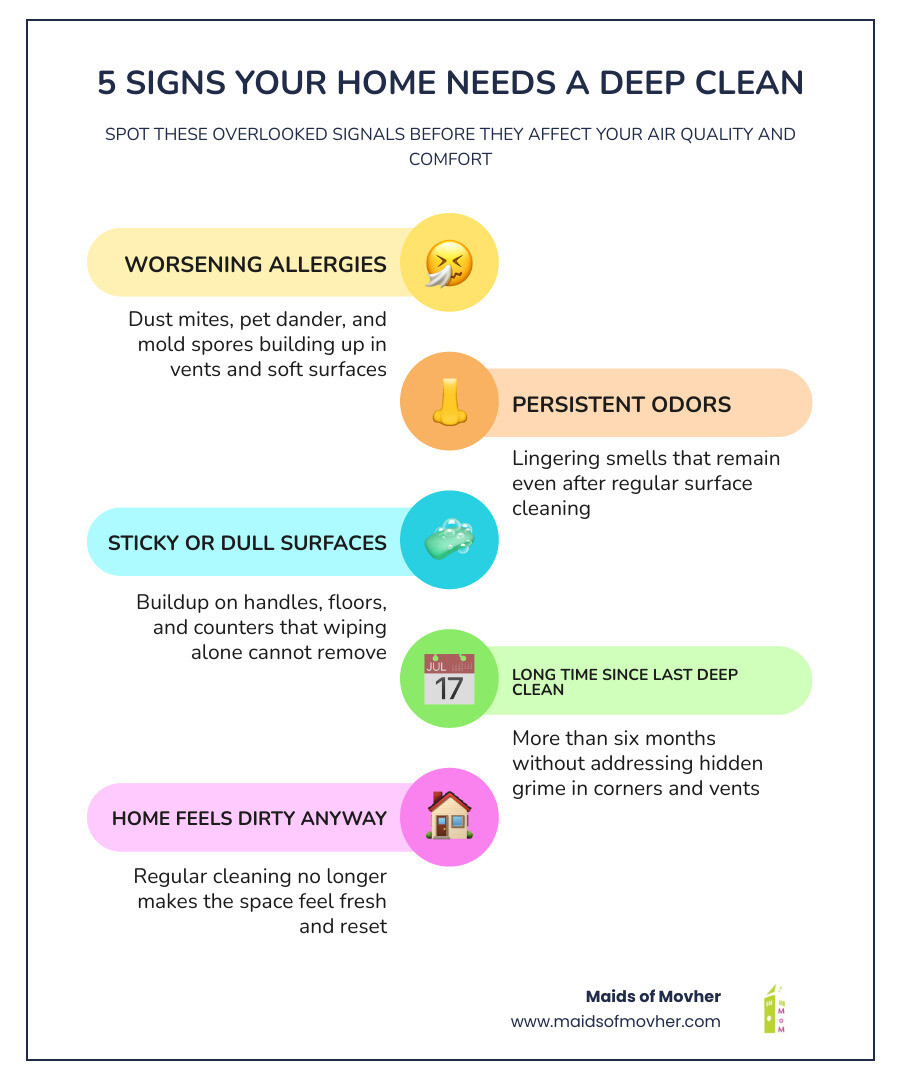
How to know if your home needs a deep clean comes down to a few clear signals most homeowners overlook. Here is a quick snapshot:
- Allergies or respiratory irritation get worse indoors — dust mites, pet dander, and mold spores are building up in vents and soft surfaces
- Lingering odors that won’t go away — even after regular cleaning, hidden grease and bacteria cause persistent smells
- Surfaces feel sticky or look dull — cabinet handles, floors, and counters have buildup that wiping alone won’t fix
- You can’t remember your last deep clean — if it’s been more than six months, hidden grime has almost certainly accumulated
- Your home feels dirty no matter what you do — regular cleaning only handles the surface; deep cleaning resets everything underneath
If two or more of these sound familiar, your home is likely overdue.
No matter how consistent your weekly routine is, every home eventually reaches a point where a mop and a quick wipe-down simply aren’t enough. Dust accumulates behind furniture, grease builds up inside appliances, and allergens settle deep into grout and vents — all in places your regular cleaning never reaches. According to cleaning experts, even the tidiest homes collect hidden grime in spots like ceiling corners, window tracks, and cabinet interiors if it has been more than six months since the last deep clean. The result is a home that looks reasonably clean on the surface but feels stale, stuffy, or just off — and that feeling is usually your first clue that something deeper is going on.
I’m Sabrina Jones, owner of Maids of Movher and a home services professional with over a decade of experience helping Spokane-area families recognize exactly how to know if your home needs a deep clean — and what to do about it. In this guide, I’ll walk you through five straightforward steps to read the signs your home is giving you.
How to Know If Your Home Needs a Deep Clean in 5 Simple Steps

If you have ever spent an entire Saturday morning sweeping, mopping, and dusting, only to look around on Sunday afternoon and feel like your living room is still dusty, you are not alone. When a home needs more than standard maintenance, continuing with your normal routine can feel like running on a treadmill — you are putting in a ton of effort but getting nowhere.
To help you assess your living space, we have broken down the evaluation process into five simple, actionable steps. By looking at your home through these different lenses, you can easily determine whether it is time for a standard touch-up or a comprehensive seasonal reset.
Step 1: Compare Routine Maintenance vs. Deep Cleaning
The first step in understanding what your home needs is recognizing that routine maintenance and deep cleaning are two entirely different types of care. Many homeowners assume that doing their weekly chores more vigorously is the same as deep cleaning. In reality, they target completely different layers of dirt.
Routine cleaning is all about surface-level upkeep. It keeps your home presentable, sanitary, and functional on a day-to-day basis. This includes tasks like wiping down kitchen countertops, sweeping and mopping the center of the floors, vacuuming main traffic lanes, and doing a quick sanitize of the bathroom sink and toilet. It is the essential “surface work” that prevents daily clutter and grime from taking over.
Deep cleaning, on the other hand, acts as a complete physical reset for your property. It targets the areas that are completely ignored during weekly maintenance. Instead of cleaning around your furniture, deep cleaning involves moving heavy pieces to vacuum the dust bunnies underneath. It means scrubbing the caked-on grease off your kitchen range hood, polishing baseboards, clearing dust out of individual air vents, and scrubbing the dark mildew out of shower grout lines.
To help visualize this difference, explore our detailed guide on Beyond the Surface: A Deep Cleaning vs Maintenance Comparison.
Here is a quick breakdown to help you compare the two:
| Feature / Task | Routine Surface Cleaning | Comprehensive Deep Cleaning |
|---|---|---|
| Primary Goal | Maintain daily hygiene and neatness | Eliminate deeply embedded grime, dust, and bacteria |
| Typical Frequency | Weekly or bi-weekly | Every 3 to 6 months (or seasonally) |
| Floor Care | Vacuuming visible rugs, sweeping, and mopping | Vacuuming under furniture, detailing edges, and scrubbing grout |
| Baseboards & Trim | Ignored or quickly dusted | Hand-wiped, scrubbed, and polished |
| Kitchen Appliances | Wiping exteriors and microwave interior | Deep scrubbing oven, refrigerator interior, and range hood |
| Bathrooms | Sanitizing toilets, mirrors, and countertops | Detailed lime-scale removal, grout scrubbing, and vent cleaning |
| High Dusting | Left alone | Cleaning ceiling fan blades, light fixtures, and crown molding |
Step 2: Spot the Physical Signs (How to Know If Your Home Needs a Deep Clean)
Once you understand the difference in scope, it is time to look for the physical indicators throughout your living spaces. Your home has several ways of showing you that dirt has migrated beneath the surface.
First, take a look at your hard floors and cabinetry. Do your hardwood or tile floors look dull, cloudy, or slightly dark even immediately after you mop them? Over time, mopping with standard household cleaners can actually leave behind a thin residue that traps dirt, creating a dull film. Similarly, check the areas around your kitchen cabinet handles and light switches. If you notice a sticky residue or dark, smudged shadows around high-touch spots, that is a clear sign that skin oils, grease, and dust have bonded together into a layer of grime that simple spray-and-wipe methods cannot dissolve.
Next, pay close attention to how quickly dust returns to your surfaces. If you thoroughly dust your living room coffee table and TV stand on Friday, only to find a visible grey layer of particles resting there by Saturday afternoon, your home is giving you a major clue. This rapid re-accumulation occurs because dust has built up in high, hard-to-reach places — like the tops of your ceiling fan blades, window casings, and HVAC registers. Every time your heating or air conditioning kicks on, or a ceiling fan spins, it redistributes those trapped particles right back into your living areas.
For a deeper look at what these physical signs mean for local properties, check out our resource on Signs Your Spokane Home Needs a Deep Clean. For those living in neighboring communities, our Deep Cleaning Spokane Valley WA Guide offers great local insights into tackling these exact physical challenges.
Step 3: Use Sensory Cues on How to Know If Your Home Needs a Deep Clean
Sometimes, you do not even need to look at a surface to know it is dirty — your nose and lungs will tell you first. Sensory cues are incredibly powerful indicators of a home’s overall cleanliness.
One of the most common sensory signs is a persistent, musty “old house” smell that lingers even after you open the windows or light a scented candle. When odors become trapped, they are usually coming from organic matter decomposing in places you cannot see. This could be pet dander embedded deep within your living room carpets, mold spores multiplying behind your bathroom caulk, or grease and food particles rotting inside the seals of your dishwasher and garbage disposal. Masking these scents with air fresheners only covers up the issue; a deep clean targets and eliminates the bacteria at the source.
Additionally, pay attention to how your body feels when you are inside. Do you find yourself sneezing, dealing with itchy eyes, or experiencing mild congestion only when you are hanging out in your living room or bedroom? If your allergies seem to flare up indoors but improve when you step outside, your home’s soft surfaces and air vents are likely saturated with microscopic irritants.
To learn more about how regional weather patterns and indoor air quality intersect, take a look at our Deep Cleaning Spokane Valley WA Guide 2.
Step 4: Identify Overlooked Areas and Household Triggers
Every household is unique, meaning the speed at which grime accumulates depends heavily on your daily lifestyle, the members of your home, and how you use your space.
If you have pets that shed, you already know that fur has a magical ability to find its way into every nook and cranny. Pet dander, hair, and outdoor dirt accumulate rapidly behind large appliances, under couch cushions, and inside window tracks. Similarly, homes with toddlers or young children experience much faster buildup. From sticky handprints on lower walls to spilled milk that seeps under the refrigerator, busy families naturally create more deep-cleaning triggers.
Furthermore, if you work from home or frequently entertain guests, your indoor foot traffic is significantly higher than average. More hours spent inside means your HVAC system works harder, your carpets absorb more soil, and your bathrooms require much more frequent sanitizing.
When evaluating your home, make sure to check these commonly overlooked areas:
- The tracks of your sliding glass doors and windows
- The narrow gap between your oven and kitchen countertops
- The interior shelves and drawers of your refrigerator and pantry
- The dusty coils behind or underneath your refrigerator
- The walls and baseboards in high-traffic hallways
If you are located in the Liberty Lake area and want a specialized strategy for addressing these hidden spots, our Deep Cleaning Guide Liberty Lake WA is an excellent resource to review.
Step 5: Establish a Sustainable Deep Cleaning Schedule
The final step is translating your findings into a manageable, sustainable schedule. Deep cleaning should not be a frantic, overwhelming reaction to a home that has gotten completely out of control. Instead, it should be a planned, proactive routine that keeps your home in a steady state of freshness.
When homeowners wait too long between deep cleans, they fall into what we call the “cleaning debt cycle.” This is when your home gets so dirty that cleaning it feels like an insurmountable, exhausting task, leading to procrastination, which only makes the buildup worse. By establishing a regular schedule — typically a thorough deep clean every 3 to 6 months — you keep the workload manageable and ensure your weekly routine remains fast and easy.
To break this exhausting pattern, read our advice on how to Stop the Deep Clean Debt Cycle with Regular Maintenance.
As of May 2026, professional home organizers recommend aligning your deep cleaning schedule with the changing seasons. A spring clean helps clear away the dust and mud accumulated during the damp Spokane winters, while an autumn deep clean prepares your home for the long, closed-window months of winter. For a complete walkthrough on planning these seasonal resets, check out our One Time Deep Cleaning Washington Complete Guide.
Why Deep Cleaning is Essential for Your Health and Air Quality
While having a sparkling, visually beautiful home is wonderful, the most important benefits of deep cleaning are actually invisible. Deep cleaning is a vital component of maintaining a healthy indoor environment for your family and pets.
Did you know that the average residential home accumulates more than 40 pounds of dust every single year? This dust is not just harmless dirt; it is a complex mixture of dead skin cells, outdoor pollen, pet dander, microscopic dust mites, and chemical residues. These particles settle deep into soft surfaces like carpets, area rugs, mattresses, and upholstered furniture.
Every time you walk across a carpet or sit on your sofa, you launch millions of these microscopic particles back into the air, where they are inhaled by your family. For individuals living with asthma, allergies, or other respiratory conditions, this constant exposure can lead to chronic irritation, poor sleep quality, and frequent flare-ups.
Furthermore, areas with high moisture levels — like your bathroom shower grout, the space behind your toilets, and the dark areas under your kitchen sink — are prime breeding grounds for mold spores and bacteria. Standard surface wiping might make these areas look clean, but it rarely penetrates deeply enough to kill the root systems of mold or sanitize the bacteria hiding in porous grout lines. A thorough deep clean utilizes targeted, sanitizing techniques to eliminate these biological hazards at the source, dramatically improving your indoor air quality and protecting your family’s physical health.
Frequently Asked Questions About Deep Cleaning
How often should a home be deep cleaned according to experts?
Most residential cleaning experts recommend scheduling a comprehensive deep clean once or twice a year for quiet, low-traffic households. However, this frequency should be adjusted based on your specific living situation.
If you have indoor pets, young children, or family members who suffer from severe allergies or asthma, experts suggest moving to a quarterly schedule (every 3 months). This prevents pet dander and dust mites from building up to levels that can trigger health issues.
For more detailed guidance on setting the perfect frequency for your household in our local area, consult our Deep Cleaning Spokane Valley Guide.
When is it better to hire professional cleaners instead of doing it yourself?
While DIY deep cleaning is entirely possible, it is incredibly time-consuming and physically demanding. A thorough, top-to-bottom deep clean of a standard three-bedroom home can easily take 8 to 12 hours of intense physical labor, often requiring you to spread the work over an entire weekend.
It is usually better to hire professional cleaners if:
- You are short on time: If you work long hours or want to spend your weekends relaxing with your family rather than scrubbing baseboards.
- You lack specialized equipment: Professional teams use commercial-grade HEPA vacuums, specialized grout brushes, and professional extension poles to reach high areas safely.
- You want a true physical reset: Professionals are trained to spot hidden grime that homeowners naturally overlook, ensuring a much more thorough, consistent result.
If you are considering outsourcing this massive chore, our Deep Cleaning Services Spokane Valley Guide can help you understand what to look for in a local professional provider.
What specific tasks are included in a thorough deep cleaning checklist?
A professional-grade deep cleaning checklist goes far beyond standard dusting and vacuuming. It is designed to address every corner of your home from top to bottom. A thorough checklist typically includes:
- High Dusting: Cleaning individual ceiling fan blades, light fixtures, crown moldings, and high ceiling corners to remove spiderwebs.
- Detailed Wall & Trim Care: Hand-wiping baseboards, door frames, window sills, and spot-cleaning walls to remove scuffs and fingerprints.
- Deep Bathroom Sanitation: Scrubbing shower tile grout, removing built-up limescale from faucets, cleaning behind the toilet, and sanitizing the exhaust fan cover.
- Kitchen Appliance Detailing: Degreasing the range hood, scrubbing the oven interior, wiping down the refrigerator coils, and cleaning inside the microwave and dishwasher.
- Vent & Return Cleaning: Vacuuming and wiping down all HVAC register vents and cold-air returns to prevent dust recirculation.
Conclusion
Recognizing how to know if your home needs a deep clean is the first step toward reclaiming a fresh, healthy, and comfortable living space. Whether your home is showing obvious physical signs like dusty baseboards and sticky cabinets, or subtle sensory cues like lingering odors and worsening indoor allergies, ignoring these warnings only makes daily maintenance harder in the long run.
At Maids of Movher, we believe that a clean home is a sanctuary that promotes comfort, health, and peace of mind. As a locally-owned and woman-owned residential cleaning company serving Spokane, Spokane Valley, Mead, Airway Heights, Liberty Lake, and the surrounding communities since 2010, we have made it our mission to brighten and bring some sparkle to our clients’ homes with superior service, integrity, commitment, and trust.
What truly sets us apart is our employee-first philosophy. We are proud to provide the highest wages in the area, offering our team members stable, rewarding careers without night or weekend shifts. Because our employees are happy, respected, and well-compensated, they stay with us for the long haul. For you, this translates directly to consistent, highly reliable service from experienced professionals who genuinely care about the quality of their work.
We are also deeply committed to the health of your family, your pets, and our local environment. That is why we utilize eco-friendly cleaning practices and safe, sustainable products that deliver a sparkling clean without leaving behind harsh chemical residues. Our pet-friendly approach ensures your furry family members remain safe and comfortable throughout the entire cleaning process.
Plus, we love giving back to the community we call home. Through our active partnership with Cleaning for a Reason, we proudly provide free house cleaning services to local cancer patients, allowing them to focus on their recovery while we take care of their homes.
Our services are about giving you back the lifestyle benefits you deserve. Instead of spending your valuable weekends scrubbing grout and dusting ceiling fans, let us handle the heavy lifting. Go spend your free time reading a great book, catching up with friends at a local Spokane coffee shop, or enjoying a movie night with your family.
Are you ready to experience the incredible feeling of a truly deep-cleaned home? Explore our professional Deep Cleaning Services today, and let us bring the sparkle back to your space!
