
What Every Spokane Homeowner Should Know Before Letting a Cleaner Through the Door
Understanding the bonded vs insured cleaning company what is the difference question is one of the most important things you can do before inviting anyone into your home. Here is the short answer:
| Protection | What It Covers | Who It Protects |
|---|---|---|
| Bonded | Employee theft, dishonest acts, non-performance | The homeowner |
| Insured (General Liability) | Accidental property damage, third-party injury | The homeowner and the business |
| Insured (Workers’ Comp) | Employee injuries on your property | The employee and the homeowner |
In plain terms: bonding is a financial guarantee that protects you if something is stolen or a service is not delivered. Insurance covers accidents — a broken fixture, a spill on your hardwood floors, or a cleaner who gets hurt while working in your home. They are two separate protections, and a reputable cleaning company should carry both.
Most homeowners see the phrase “bonded and insured” on a website and assume it all means the same thing. It does not. The details behind those words — what type of bond, what kind of insurance, how much coverage, and whether it is current — are what actually determine whether you are protected if something goes wrong.
I’m Sabrina Jones, owner of Maids of Movher and a Spokane-based entrepreneur with over a decade of experience building home service companies on a foundation of trust and transparency — and understanding exactly what separates a bonded vs insured cleaning company and what that difference means for homeowners has been central to how I run my business. Let’s walk through everything you need to know so you can hire with confidence.
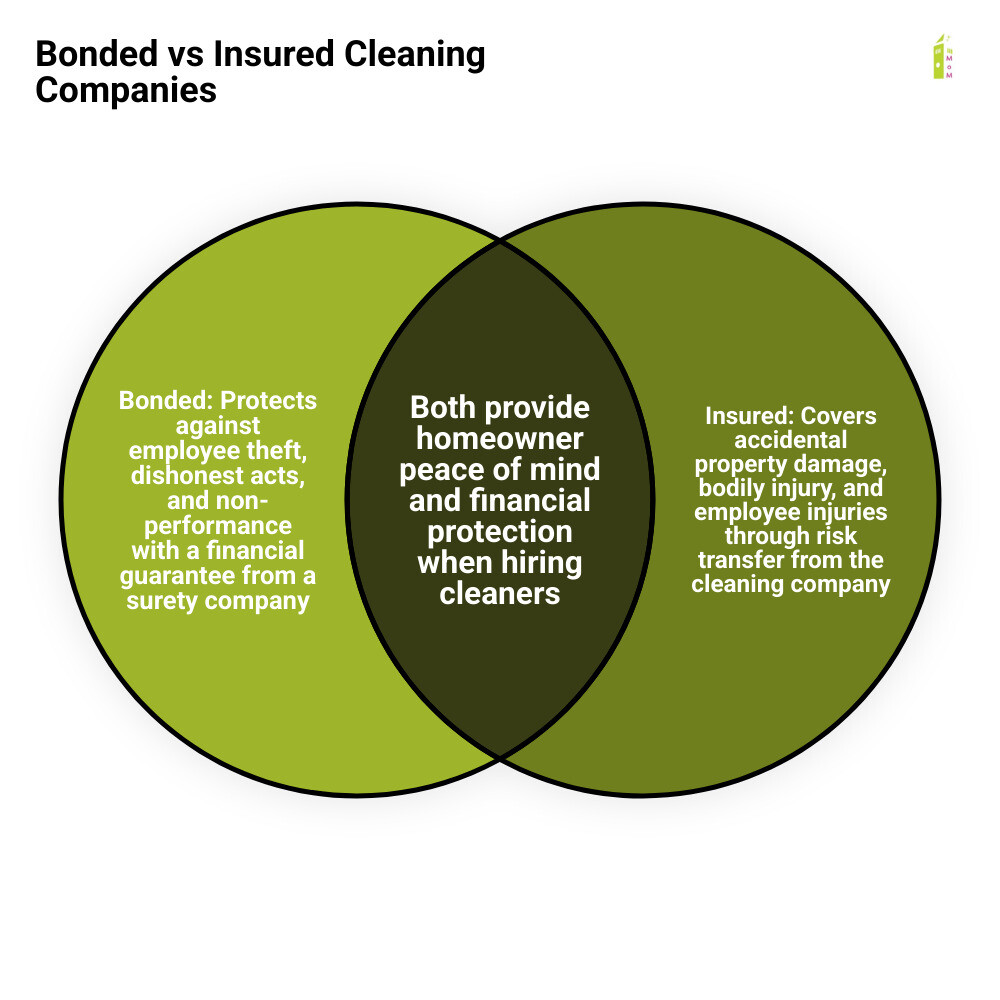
Bonded vs Insured Cleaning Company What Is the Difference?
The simplest answer is this: a bond is a promise of accountability, while insurance is protection against accidents and injuries.
That sounds tidy, but there is more going on underneath.
A bond usually involves three parties:
- The cleaning company
- The customer
- The surety company that backs the bond
Insurance is usually a two-party arrangement:
- The cleaning company
- The insurance carrier
That difference matters because bonds and insurance are built for different problems.
| Protection | Main Purpose | Common Example | What to Request |
|---|---|---|---|
| Bond | Protect against theft, dishonesty, or certain failures to perform | Cash or jewelry goes missing | Bond certificate |
| General liability insurance | Cover accidental damage or third-party injury | A cleaner scratches flooring or breaks decor | Certificate of insurance |
| Workers’ compensation | Cover employee injury on the job | A cleaner slips and is hurt in your home | Proof of workers’ comp coverage |
Research consistently shows that companies operating with stronger financial safeguards tend to be more accountable overall. In settings where surety bonds are required, 96% of owners required pre-qualification, and bonded work was reported as far more likely to finish on time. Other industry data shows bonded and insured firms reaching completion rates in the low-to-mid 90% range, compared with lower completion rates for non-bonded firms, plus fewer callbacks for unfinished work. In plain English: paperwork does not clean your kitchen, but good business practices usually travel together.
What “bonded” means for a cleaning company
When a cleaning company is bonded, it typically means it carries a surety bond or janitorial bond designed to protect customers from certain dishonest acts by employees, such as theft.
You may also hear terms like:
- Surety bond
- Janitorial bond
- Fidelity bond
For homeowners, the practical takeaway is simple: if an employee steals from your home and the claim is valid under the bond, the bond may reimburse you up to the bond terms.
Depending on the bond and service agreement, bonding can also help with certain non-performance issues, such as a company taking payment and failing to deliver the agreed service.
What bonding does not usually mean:
- It does not automatically cover accidental breakage
- It does not replace liability insurance
- It does not guarantee every dispute will be paid
A bond is not a magic force field. It is a specific financial instrument with rules, limits, and exclusions.
What “insured” means for a cleaning company
When a cleaning company is insured, it means the company carries one or more active insurance policies.
For residential cleaning, the most important ones are:
- General liability insurance
- Workers’ compensation insurance
- Commercial auto insurance if company vehicles are involved
- Sometimes umbrella or professional liability coverage
General liability insurance is what helps if a cleaner accidentally damages your property or causes bodily injury to someone else during the visit.
Workers’ compensation matters if an employee gets hurt while working in your home. Without it, a homeowner can end up tangled in a messy liability situation. Nobody wants a dusting appointment to turn into a legal headache.
A reputable company should be able to provide a current certificate of insurance, often called a COI, showing active dates and the legal business name.
Bonded vs insured cleaning company what is the difference in plain English?
Here is the plain-English version:
- If something is stolen, bonding is the protection you look at.
- If something is accidentally damaged, insurance is the protection you look at.
- If a worker is injured, workers’ comp is the protection that matters.
Another useful distinction: with a surety bond, the surety may pay a valid claim and then seek repayment from the business. With insurance, covered losses are generally handled through the policy according to premiums, deductibles, and coverage terms.
So if you are wondering, bonded vs insured cleaning company what is the difference, the answer is not “they are basically the same.” They are absolutely not the same. You want both.
What Bonding Protects Homeowners From

Bonding is mainly about dishonesty and accountability, not accidents.
For homeowners, that usually means protection related to:
- Employee theft
- Dishonest acts
- Certain breaches of service agreements
- Some forms of non-performance, depending on the bond and contract
It can also create a clearer claims path. Instead of arguing endlessly with a company, you may be able to file a claim with the bond provider and have the matter investigated.
How bonding helps if items go missing
Let us say cash disappears from a drawer, or a piece of jewelry cannot be found after a cleaning visit. That is the type of situation bonding is meant to address.
If you suspect theft, a bond may offer:
- A formal reimbursement path
- An outside claims review process
- Documentation requirements that create accountability
You would typically need to document the loss carefully. That may include:
- Photos
- A written timeline
- A copy of your service agreement
- A police report if appropriate
- A list of missing items and estimated value
Important note: bonding is not the same as “we believe something is missing, therefore it is automatically paid.” Proof matters, and the surety will investigate.
How bonding can help with non-performance or unfinished work
Some bonds or service guarantees may also help if a company fails to perform as agreed.
Examples might include:
- A paid move-out clean that never happens
- A crew that leaves before finishing the contracted work
- A no-show tied to a written agreement
This is especially important when timing matters, like move-out cleaning before a lease deadline or real estate showing. Industry data suggests bonded and insured firms tend to complete work more reliably and generate fewer callbacks for incomplete jobs. Again, the bond itself does not mop the floor, but it often reflects a more structured and accountable operation.
What bonding usually does not cover
This is where a lot of homeowners get tripped up.
Bonding usually does not cover:
- A broken vase
- Water damage from an accident
- Scratched hardwood floors
- Carpet damage caused by negligence
- A cleaner slipping and getting injured
Those are generally insurance issues, not bond issues.
So if someone says, “Don’t worry, we’re bonded,” that is only half the story. If they knock over your lamp, the bond probably is not what saves the day.
How Insurance Protects Your Home, Property, and the People Working Inside It
Insurance is what steps in when something goes wrong by accident.
That includes two big categories:
- Damage to property
- Injuries that happen during the job
Insurance transfers financial risk away from the homeowner and business into the policy structure, subject to coverage terms and exclusions.
Average claims for covered incidents can easily run into the tens of thousands of dollars per event. That is why this is not a tiny technical detail. It is a real household risk issue.
Bonded vs insured cleaning company what is the difference when something is damaged?
If a cleaner accidentally breaks a fixture, damages flooring, or causes a spill that ruins a rug, that is generally a general liability insurance matter.
Common examples include:
- Breaking a decorative item while dusting
- Damaging a countertop or appliance
- Scratching floors while moving equipment
- Causing water overflow or similar accidental damage
In those cases, the cleaning company’s insurer may review the incident and, if covered, pay for repair or replacement according to the policy terms.
That is the heart of the damage question in bonded vs insured cleaning company what is the difference:
- Bonding addresses theft or dishonesty
- Insurance addresses accidental damage
Why workers’ compensation matters for homeowners
Workers’ compensation is one of the most overlooked protections in residential cleaning.
If a cleaner slips on wet flooring, strains a back lifting something, or is otherwise injured on your property, workers’ comp is the policy meant to handle medical care and lost wages for employees.
Why should homeowners care?
Because without proper workers’ compensation coverage, the situation can get ugly fast. A homeowner may face claims, disputes, or involvement through their own insurance. Some research has even noted the risk of substantial homeowners policy premium increases after claims involving uninsured workers.
So yes, workers’ comp may sound like a “business problem,” but when the work is happening in your hallway, kitchen, or bathroom, it can become your problem too.
What insurance a reputable cleaning company should carry
At a minimum, a professional residential cleaning company should carry:
- General liability insurance
- Workers’ compensation insurance for employees
- Commercial auto insurance if staff drive as part of service
- Umbrella liability coverage for extra protection in some cases
- Professional liability coverage where appropriate
Here is a practical checklist homeowners can use:
- Ask for a current certificate of insurance
- Check that the company name matches the legal business name
- Review effective dates to confirm the policy is active
- Ask whether all workers entering the home are covered
- Ask whether employees or subcontractors will perform the work
- Confirm workers’ comp applies to the people being sent to your home
Industry guidance commonly points to general liability limits around $1 million per occurrence and $2 million aggregate as a standard benchmark, but what matters most for homeowners is not memorizing policy jargon. It is verifying that coverage is real, current, and appropriate for the service being performed.
Common Myths, Red Flags, and Verification Steps
This topic is full of myths, and some of them are surprisingly persistent.
Myths homeowners often believe about bonded and insured cleaners
Here are some of the big ones:
Myth: Bonded and insured mean the same thing. They do not.
Myth: If a company is bonded, accidental damage is covered. Usually not.
Myth: If a company says it is insured, that automatically includes workers’ comp. Not necessarily.
Myth: A verbal “yes, we’re covered” is enough. It is not.
Myth: The lowest price is the best value. Sometimes the cheapest option is just the option with the fewest safeguards.
Also, “bonded and insured” does not automatically mean background-checked. That is a separate question, and a very fair one to ask.
How to verify if a cleaning company is truly bonded and insured
Verification is not rude. It is smart.
Ask for:
- A certificate of insurance
- Proof of workers’ compensation
- A bond certificate or bond information
- The legal business name on all documents
- Effective dates showing current coverage
Then review:
- Is the coverage active?
- Does the business name match the contract?
- Does the company explain coverage clearly?
- Are the documents current for this year?
- Are all workers covered, or only direct employees?
For recurring service, it is wise to review updated documentation annually.
If you want more guidance on what quality and accountability look like in practice, here is more on quality assurance in Washington house cleaning.
Red flags that suggest you should keep looking
Some warning signs are hard to ignore:
- The company refuses to provide proof
- Answers are vague or evasive
- Documents are expired
- The business name on paperwork does not match the company you are hiring
- The company cannot explain how worker injuries are handled
- There is confusion about whether cleaners are employees or subcontractors
- They lean heavily on marketing language but avoid specifics
Good companies expect these questions. Honest documentation should not feel like a treasure hunt.
Why Homeowners Should Care Before Booking Any Cleaning Service
For homeowners in Spokane, Spokane Valley, Mead, Airway Heights, Liberty Lake, and nearby communities, this is not just legal fine print. It is about protecting your home, your schedule, and your peace of mind.
The real risks of hiring cleaners without bonding or insurance
When a cleaner is not bonded or insured, the risks can land on you:
- Paying out of pocket for accidental damage
- Losing property with no clear reimbursement path
- Dealing with unresolved disputes over missed or incomplete work
- Facing liability questions if someone is injured
- Triggering claims on your own homeowners policy
- Potential premium increases after a claim
And if a covered incident can cost tens of thousands of dollars, a cheaper upfront choice can become expensive in a hurry.
Why these protections often signal professionalism and accountability
Bonding and insurance are not proof that a company is perfect. But they do signal a few important things:
- The business plans ahead
- The business has formal structure
- The business is willing to be verified
- The business understands risk and responsibility
- The business is more likely to maintain clear policies and standards
Research in bonded work environments has also linked bonding requirements with stronger pre-qualification, better on-time performance, higher completion rates, and fewer callbacks. That lines up with common sense: companies that invest in doing things properly usually invest in training, processes, and follow-through too.
How this fits into the bigger hiring decision
Bonding and insurance are part of a bigger picture that includes:
- Whether cleaners are employees or contractors
- Whether staff are screened and trained
- Whether the company offers a satisfaction guarantee
- Whether there is backup coverage if someone is unavailable
- Whether communication is clear before the first appointment
If you are weighing those bigger questions, these resources may help:
- The Honest Truth About Hiring an Independent Cleaner vs. a Cleaning Company
- Guaranteed House Cleaning Washington Guide
Frequently Asked Questions About Bonded and Insured Cleaning Services
Is bonded better than insured, or do I need both?
You want both.
Bonding helps protect you if there is theft, dishonesty, or certain non-performance issues. Insurance helps protect you if there is accidental damage or a worker injury. One does not replace the other.
Can I ask a cleaning company for proof before they enter my home?
Yes. Absolutely.
It is normal to request:
- A certificate of insurance
- Workers’ comp confirmation
- Bond information
A professional company should be prepared for that question and answer it clearly.
Does “bonded and insured” also mean background-checked?
No. That is separate.
A company may be bonded and insured without having a strong background screening process. Ask directly whether every person entering your home is screened, how often, and whether they are employees or subcontractors.
Conclusion
When homeowners ask us about bonded vs insured cleaning company what is the difference, our answer is simple: bonding protects against theft and certain failures to perform, while insurance protects against accidents, damage, and worker injuries. You should not have to guess which safeguard is in place after something goes wrong.
At Maids of Movher, we believe trust is built before the first mop bucket comes out. As a locally owned and woman-owned residential cleaning company serving Spokane, Spokane Valley, Mead, Airway Heights, Liberty Lake, and surrounding Washington communities since 2010, we believe in doing business with integrity, commitment, and transparency. Making Homes Sparkle Since 2010 is not just a tagline for us. It reflects how we show up for our clients and our community.
We are proud to provide recurring cleaning, deep cleaning, and move-in/move-out cleaning with eco-friendly, pet-friendly practices and a satisfaction-focused approach. We also believe happy, well-paid employees create the consistency and reliability homeowners deserve. That is good for our team, good for our clients, and good for the long run.
If you would like to keep learning before booking, here are a few helpful next steps:
- The Local Advantage: Why Small Cleaning Companies Outshine the Rest
- Why Local Cleaners Often Beat the Big Box Franchises
- Visit Maids of Movher
The right cleaning company should make your life easier, not add hidden risk. Ask the questions, verify the coverage, and hire with confidence.
