
Why Most Small Closets Feel Impossible (And What to Do About It)
The best closet organization ideas for small spaces start with one simple truth: most small closets aren’t disorganized because they’re too small — they’re disorganized because they’re missing a system.
Here are the most effective ways to maximize a small closet fast:
- Declutter first — remove everything and sort into Keep, Donate, and Store piles before buying a single organizer
- Switch to slim velvet hangers — immediately reclaims 30–40% of rod space
- Add a second tension rod — nearly doubles hanging capacity without drilling
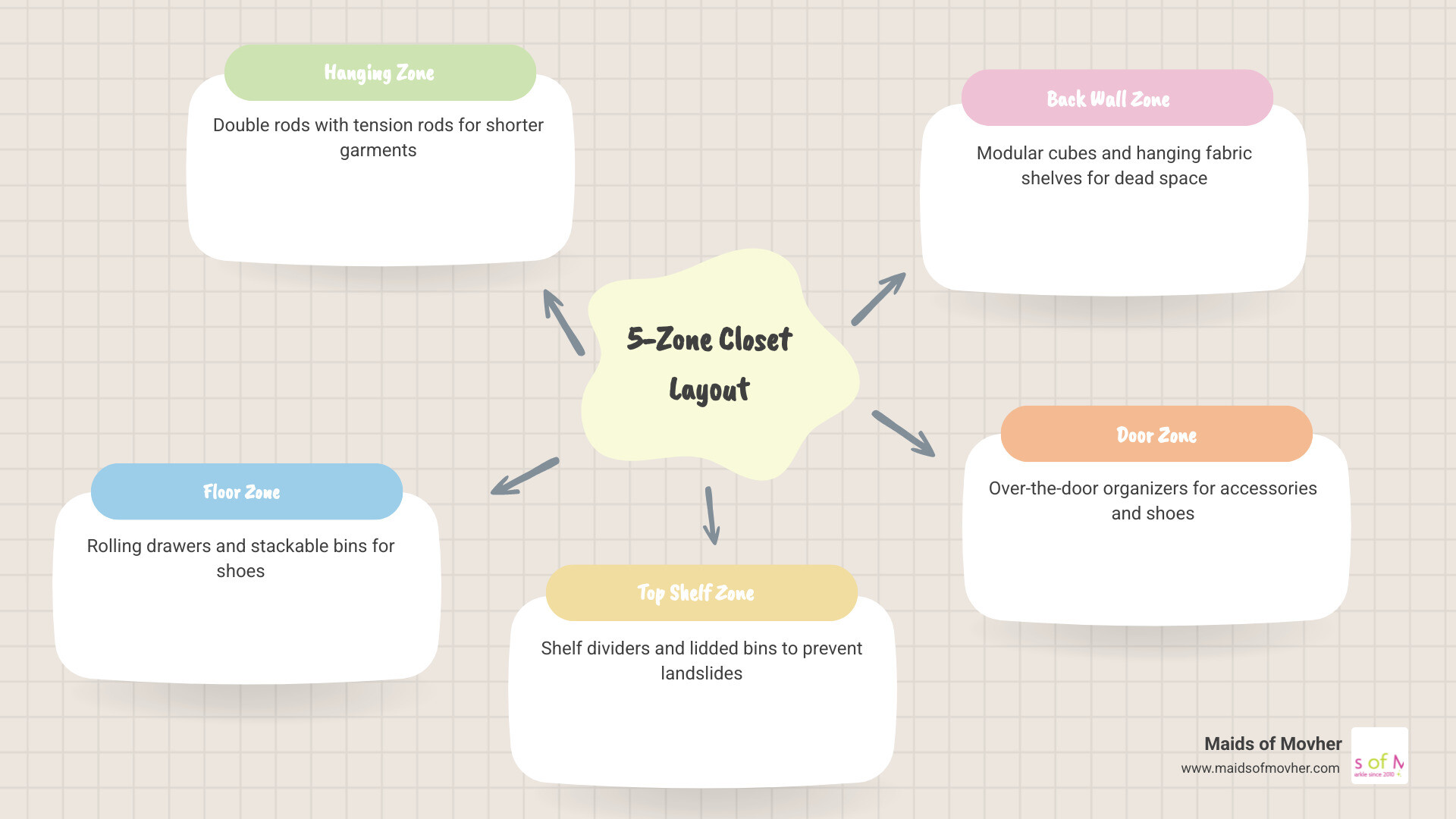
- Use the five zones — hanging, floor, top shelf, back wall, and door each hold untapped storage potential
- File-fold bulky items — sweaters and jeans take up far less room when folded vertically into bins
- Add an over-the-door organizer — turns wasted door space into accessible storage for shoes, accessories, or everyday items
- Use matching bins on the top shelf — prevents the “sweater landslide” and makes the space feel twice as large
According to research, 80% of homeowners report their closets are too small or poorly organized — and a well-organized closet can save up to 30 minutes every single morning. That’s not just a tidier space. That’s a calmer, less stressful start to your day.
If you’ve ever opened your closet door and felt a wave of frustration wash over you before you’ve even had coffee, you’re in the right place. Visual clutter in a small closet doesn’t just slow down your morning routine — it creates a low-level stress that follows you through the day. The good news is that most small closets are fixable without custom built-ins, expensive systems, or a single hole in the wall.
I’m Sabrina Jones, entrepreneur and owner of Maids of Movher, and after more than a decade helping Spokane families create cleaner, more functional homes, I’ve seen how the right closet organization ideas for small spaces can completely transform a morning routine and a mindset. This guide walks you through everything we know works — zone by zone, step by step.
The Golden Rules of Closet Organization Ideas for Small Spaces
Before you run out to the store to buy cute baskets and plastic drawers, we need to talk about the most common small-closet mistake: trying to organize clutter. Organizing products don’t fix clutter; they just make it look expensive.
To build a system that actually lasts, we must follow a few non-negotiable golden rules. If you want a deeper dive into the psychology of letting go of clutter, check out our Closet Cleanout 101: The Practical Guide to a Mess-Free Home.
Step 1: The Keep, Donate, and Store Audit
The fastest way to gain 40% more space in a tiny closet is to clear out what you don’t wear. We recommend using a modified version of the 5-5-5 Rule of Decluttering combined with a strict seasonal audit.
To overcome the psychological “endowment effect” (the tendency to overvalue things simply because we own them), ask yourself these three objective questions:
- Did I wear this in the last 12 months?
- If I saw this in a store today, would I buy it again?
- Does this fit my current body and lifestyle in June 2026, or am I keeping it for a “past life stage”?
Once you pull everything out of your closet, sort it into three distinct piles:
- Keep: Items you love, wear regularly, and fit you right now.
- Donate: Clothes in good condition that you no longer wear. (Tip: Instead of letting donation bags sit by your bedroom door for months, load them into your car immediately).
- Store: Off-season items, sentimental clothing, or formal wear.
For sentimental items you can’t wear but won’t donate, place them in a labeled, acid-free storage box with a few silica gel packs to prevent moisture damage. For off-season clothes (like heavy winter coats in the middle of a hot Spokane summer), use vacuum storage bags. These shrink bulky fabrics down to flat packages that slide easily under your bed or onto a high shelf.
Step 2: Swap to Uniform Slim Hangers
If you are still using mismatched plastic, wooden, or wire hangers, this is your sign to replace them. Swapping to uniform slim velvet hangers is the cheapest, highest-impact upgrade you can make.
Velvet hangers are incredibly thin, allowing you to fit up to 40% more clothing on the exact same rod. Plus, their non-slip texture means your silk blouses and wide-neck tees won’t slide off onto the floor. Best of all, having matching hangers instantly makes a small closet look cohesive, organized, and calm.
5 Zones to Maximize in a Tiny Closet Without Drilling
If you are renting an apartment in Spokane Valley or Mead, or simply don’t want to deal with drywall anchors and power tools, you can still achieve a custom-closet feel. The secret lies in attacking five specific zones that builder-grade closets almost always waste.
For more clever ideas on keeping your entire home organized, take a look at our guide on 35 Clever Back to School Home Organization Ideas.
Zone 1: The Hanging Zone (Double Your Rods)
Most standard closets feature a single hanging rod set about 65 inches off the floor. This leaves nearly 30 inches of completely dead space underneath.
You can instantly double your hanging capacity without drilling by adding a hanging double-rod extender or an adjustable tension rod. Hang your shorter garments—like shirts, skirts, and folded pants—on the lower rod, and reserve one small section of the main rod for long dresses or coats.
Zone 2: The Floor Zone (Ditch the Shoe Pile)
The closet floor is where organization goes to die. Once a single pair of shoes is kicked onto the floor, a chaotic pile quickly forms.
To reclaim this zone, keep the floor as clear as possible. If you must use the floor, opt for low-profile rolling drawers or stackable plastic bins. This makes it easy to slide storage out of the way when you need to reach hanging clothes.
Zone 3: The Top Shelf Zone (Prevent the Sweater Landslide)
The top shelf of a closet is notorious for the “sweater landslide”—you pull one knit down, and three others collapse on your head.
To tame this zone, use clear acrylic shelf dividers or fabric storage bins. Dividers keep stacks of sweaters, jeans, or sweatshirts standing upright in neat, vertical columns. If you use bins, choose matching fabric or clear plastic ones, and label the front so you always know what’s inside.
Zone 4: The Back Wall Zone (Freestanding Systems)
If your closet is deep enough (at least 22 inches), the back wall is an absolute goldmine. You can slide a freestanding modular cube organizer or a slim, freestanding wire shelving unit right against the back wall. This gives you instant shelving for folded clothes, hats, or accessories without attaching anything to the drywall.
Zone 5: The Door Zone (The Ultimate Real Estate)
The back of your closet door is the most underutilized space in the entire room. An over-the-door pocket organizer or a wire rack system can hold dozens of small items. Use it for shoes, belts, jewelry, scarves, or even rolled-up t-shirts and activewear. It keeps daily essentials at eye level and completely off your shelves.
Smart Storage Solutions for Shoes, Sweaters, and Accessories

Once you’ve mapped out your zones, it’s time to tackle the trickiest items in your wardrobe: bulky knits, shoes, and small accessories. To keep your storage areas looking as fresh as the rest of your home, you might also enjoy reading The Complete Guide to Cleaning and Organizing Your Laundry Space.
How to Store Bulky Sweaters and Knits
Never hang heavy sweaters! Gravity will stretch out the shoulders and ruin the shape of your favorite knits. Instead, use the file-folding technique (folding clothes into neat, compact rectangles and standing them upright rather than stacking them). Place these file-folded sweaters inside fabric bins on your top shelf or in under-bed storage containers.
Compact Shoe Storage That Actually Works
Instead of letting shoes clutter your closet floor, try these space-saving strategies:
- Shoe Slots: These clever double-decker organizers let you stack one shoe directly on top of its partner, instantly cutting your shoe storage footprint in half.
- Stackable Shoe Shelves: A slim, 3-tier shoe rack can sit beneath your hanging shirts.
- Knee-Height Baskets: For daily-wear shoes like sneakers or sandals, a pretty woven basket on the floor keeps them contained but easy to grab.
Organizing Accessories and Small Items
Keep small accessories from getting lost in the shuffle:
- Drawer Dividers: If you have a small dresser or drawers inside your closet, use honeycomb or strip dividers to keep socks, underwear, and belts separated.
- Bra Organizers for Scarves: Repurpose a fabric bra organizer with small square compartments to store rolled-up scarves, swimsuits, or rolled belts.
- Jewelry Hooks: Mount adhesive hooks to the inner walls of your closet to hang necklaces, preventing tangles.
Quick Reference: To Hang or To Fold?
| Garment Type | Best Storage Method | Why? |
|---|---|---|
| Blouses & Button-Downs | Hang (on slim velvet hangers) | Prevents wrinkles and keeps them visible |
| Bulky Sweaters & Knits | Fold (in bins or drawers) | Hanging stretches out knits and ruins shoulders |
| T-Shirts & Activewear | File-Fold (in baskets) | Saves space and lets you see every shirt at a glance |
| Jeans & Denim | Fold or Hang | Durable enough for either; folding saves rod space |
| Dresses & Jumpsuits | Hang | Prevents deep creases in long fabrics |
Sharing a Tiny Closet: How to Divide Space Fairly
Sharing a small closet with a partner or sibling can be a recipe for morning frustration—especially if one of you is a morning lark and the other is a night owl, or if one person has a significantly larger wardrobe.
To keep the peace, you need a clear, physical division of space. For more tips on managing a busy household, check out The Ultimate Guide to Back to School Cleaning and Organization.
Divide and Conquer with Vertical Zones
Don’t just draw an imaginary line down the middle of the rod. Instead, divide the closet into distinct vertical zones:
- Establish Clear Boundaries: Assign one side of the closet to each person. Use different colored hangers or a physical hanging divider to mark the boundary.
- Coordinate Morning Routines: If one partner gets up at 5:00 AM while the other sleeps, store the early riser’s daily essentials (like work uniforms or activewear) in a dresser outside the closet or even in a living room credenza. This prevents waking up the sleeping partner.
- Utilize External Storage: If the closet simply cannot hold both wardrobes, perform an honest space audit. The person with more clothes can store out-of-season items in under-bed bins or a separate wardrobe cabinet.
Frequently Asked Questions About Small Closet Organization
What are the best DIY closet organization ideas for small spaces on a budget?
You don’t need to spend a fortune to organize your closet. If you are working with a budget under $100, focus on high-impact, low-cost structural changes rather than buying expensive matching storage systems:
- Tension Rod ($15 – $20): Instantly doubles your hanging space.
- Slim Velvet Hangers ($15 – $25 for a pack of 50): Frees up massive amounts of rod space.
- Over-the-Door Organizer ($15 – $25): Reclaims wasted door space.
- Fabric Bins ($15 – $20 for a 3-pack): Tames the top shelf.
- Repurposed Boxes (Free): Don’t buy drawer organizers! Clean shoe boxes or sturdy gift boxes make excellent, free drawer dividers for socks and t-shirts.
How do I maintain closet organization ideas for small spaces long-term?
A great organization system is only as good as the habits that support it. To keep your small closet from sliding back into chaos, adopt these three simple routines:
- The One-In, One-Out Rule: If you buy a new sweater, you must donate or sell an old one. This keeps your wardrobe volume stable.
- The 5-Minute Daily Return: Before bed, hang up your clothes or put them in the hamper. Never let them pile up on “the chair.”
- The Weekly 15-Minute Reset: Every Sunday, take fifteen minutes to straighten up your shoes, re-file any messy t-shirts, and ensure everything is back in its designated zone.
How do you organize a small closet with no built-in shelves?
If your closet is just a bare alcove with a single rod, you can build a highly functional system using freestanding, non-permanent furniture:
- Freestanding Garment Racks: A sturdy, freestanding metal clothing rack can be placed inside the closet or against an empty bedroom wall. Many models come with built-in top and bottom shelves.
- Modular Cube Organizers: Place a 6-cube or 9-cube organizer on the closet floor. Use the open shelves for folded jeans and sweaters, and insert fabric drawers for smaller items.
- Hanging Fabric Shelves: If you have a rod but no shelves, a hanging fabric shelf column velcroed to the rod gives you instant vertical shelving for folded clothes.
Conclusion
At the end of the day, organizing your closet isn’t just about making your clothes look pretty. It’s about reclaiming your time, reducing your morning stress, and giving yourself a calm space to start and end your day. When your home is organized, life just runs a little smoother.
Of course, keeping up with home organization and deep cleaning can be tough when you’re balancing work, family, and trying to enjoy your weekends in the beautiful Inland Northwest. That’s where we come in!
At Maids of Movher, we’ve been Making Homes Sparkle Since 2010. As a locally and woman-owned residential cleaning company, we serve families across Spokane, Spokane Valley, Mead, Airway Heights, and Liberty Lake.
Our mission is simple: to brighten and bring some sparkle to our clients’ homes with superior service, integrity, commitment, and trust. Because we believe in taking care of our team, we offer the highest wages in the area and never work nights or weekends. This employee-first philosophy means our happy, experienced professionals stay with us, ensuring you receive consistent, reliable, and pet-friendly cleaning every single time.
Let us handle the heavy lifting of keeping your home clean so you can spend your weekends exploring the Centennial Trail, hanging out with family, or just relaxing in your beautifully organized bedroom.
Ready for a clean, sparkling home? Explore our https://www.maidsofmovher.com/cleaning-checklists/ and reach out to us today to schedule your next service!
