
Why You Should Declutter and Organize Your Closets
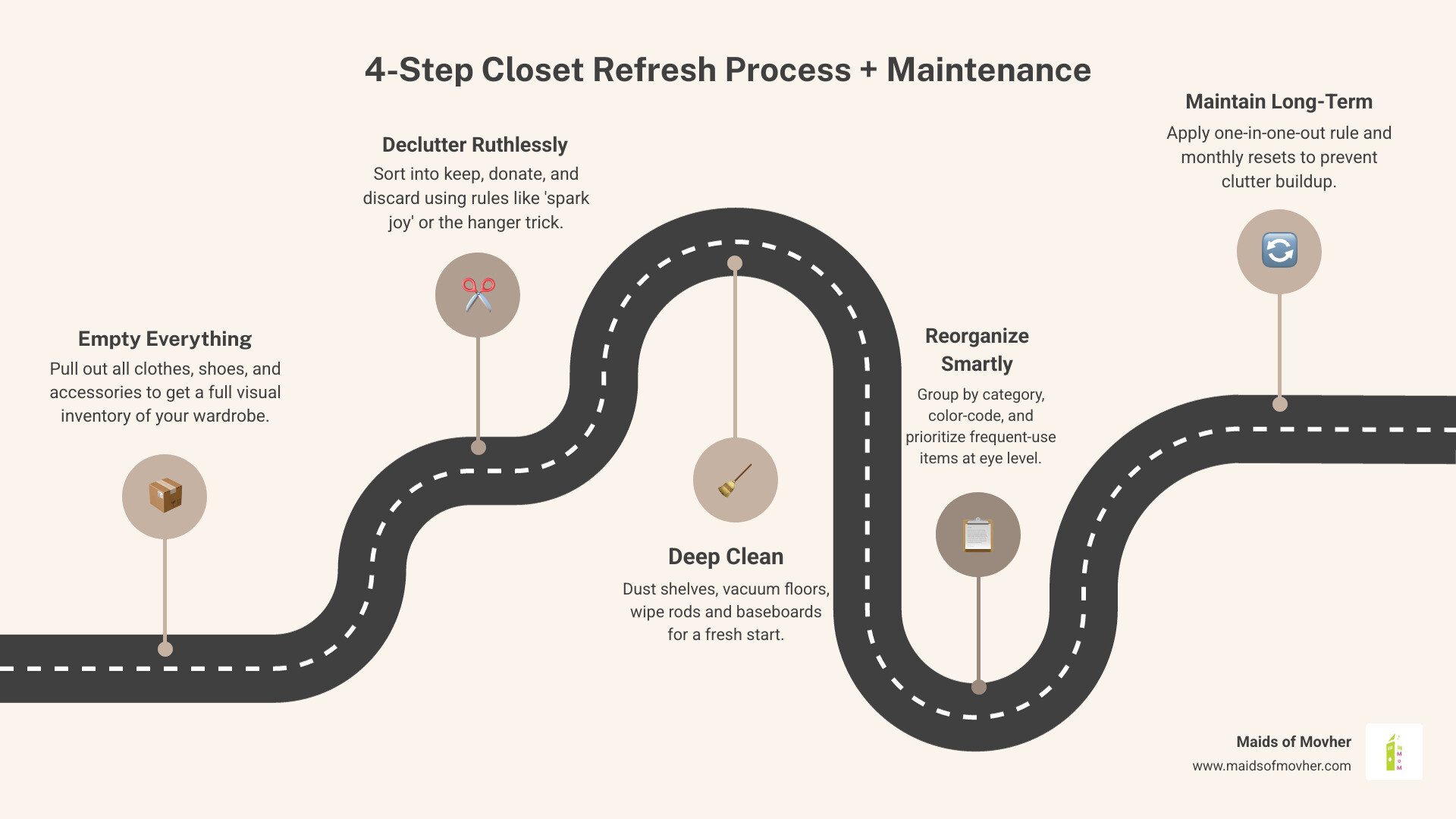
How to clean and organize your closets is simpler than it looks when you break it into clear steps:
- Empty everything out – Pull all items from your closet so you can see what you actually have.
- Declutter first – Sort into keep, donate, and discard piles before putting anything back.
- Clean the empty space – Wipe shelves, vacuum the floor, and wipe down rods and baseboards.
- Reorganize intentionally – Return only what you’re keeping, grouped by category and frequency of use.
- Build maintenance habits – Use simple rules like one-in-one-out to keep it tidy long-term.
You open your closet door, reach for one specific shirt, and somehow end up holding four things that aren’t it. Sound familiar? A disorganized closet doesn’t just waste your morning — research shows that living with clutter is a real source of anxiety, and studies suggest women alone spend nearly a year of their lives standing in front of their wardrobe trying to decide what to wear. That’s a lot of time and mental energy spent on something that should be effortless.
The good news is that a clean, organized closet isn’t just for people with walk-in showrooms or a professional designer on speed dial. It’s achievable for any home, any closet size, and any lifestyle — and the payoff goes far beyond finding your shirt faster. People who tackle their closets consistently report better moods, smoother mornings, and even fewer impulse purchases because they finally know what they already own.
Spring cleaning has been a household tradition for centuries — originally a practical necessity in frontier homes where winter fires left behind layers of soot that needed clearing out each year. Today, the same spirit of seasonal renewal applies to your wardrobe. Whether you’re doing a full spring overhaul or a quick weekend reset, this guide walks you through every step.
I’m Sabrina Jones, owner of Maids of Movher and a home services professional with over a decade of experience helping Spokane-area families create cleaner, more functional living spaces — and knowing how to clean and organize your closets is one of the highest-impact changes you can make to your daily routine. Let’s walk through exactly how to do it right.
Mastering the Art of How to Clean and Organize Your Closets
The secret to a successful closet overhaul isn’t buying fancy bins first; it’s the mental and physical preparation that happens before you ever touch a hanger. We always recommend starting with a visual inventory. This means pulling everything out. It sounds daunting, but you cannot organize what you cannot see. When you see thirteen pairs of nearly identical black leggings piled on your bed, the decision to downsize becomes much easier.
As we sort through the piles, we like to use a few tried-and-true methods to help our clients make decisions:
- The Rule of 3: If you can’t imagine three realistic ways to wear an item with clothes you already own, it’s probably time to let it go.
- KonMari ‘Spark Joy’: Hold the item. Does it make you feel good? If it only brings up guilt (like that expensive dress that never fit), it’s cluttering your mind as much as your closet.
- The 12-12-12 Rule: Find 12 items to donate, 12 to throw away (damaged beyond repair), and 12 to keep. It’s a great way to gamify the process.
- The “Would I Buy This Today?” Question: If you were at the NorthTown Mall or Spokane Valley Mall right now and saw this item on a rack, would you spend money on it? If the answer is no, why is it taking up “prime real estate” in your home?
For those who struggle with the “maybe” items, we suggest the “outbox” or “no contact” method. Put those questionable items in a bin or a separate bag. If you haven’t reached for them in six months to a year, donate them without looking inside again. To keep your momentum going for the rest of the house, you can refer to our Cleaning Checklists to stay on track.
Deep Cleaning Your Closet Before Reorganizing

Once the closet is empty, it’s time for the “clean” part of how to clean and organize your closets. Closets are notorious for trapping dust, pet hair, and allergens because they rarely get the deep attention that kitchens or bathrooms do. Since April 2026 brings those longer days and fresh Spokane air, it’s the perfect time to open the windows and get to work.
Start from the top and work your way down. Dust the high shelves where seasonal items usually sit, then wipe down the hanging rods. You’d be surprised how much dust builds up on the very things holding your clean clothes! Next, wipe down the walls and baseboards. In our experience, baseboards in closets are often overlooked for years.
Vacuuming the floor is essential, especially in the corners where “dust bunnies” thrive. If you have a reach-in closet, don’t forget the tracks of the sliding doors. For those with pets in Liberty Lake or Mead, using a vacuum with a HEPA filter is a game-changer for air quality.
If your closet has a lingering “stale” smell, now is the time for odor control. Avoid heavy perfumes; instead, ensure everything is dry before putting it back. You can also use small bags of activated charcoal or cedar blocks to keep things smelling fresh naturally. If you’re tackling this as part of a larger seasonal transition, check out The Ultimate Guide to Back to School Cleaning and Organization for more deep-cleaning insights.
Smart Strategies for How to Clean and Organize Your Closets in Small Spaces
In many older homes in Spokane and Airway Heights, closet space is at a premium. When space is tight, you have to think vertically. The goal is to maximize every square inch without making the space feel cramped.
One of the most effective tools we recommend is the slim velvet hanger. These can recover 30–40% of your rod capacity compared to bulky plastic or wooden hangers. Plus, the velvet texture prevents your blouses from slipping off onto the floor.
Other small-space heroes include:
- Double Rods: If you have high ceilings, adding a second hanging rod below the first can literally double your hanging space for shirts and folded pants.
- Over-the-Door Organizers: These are perfect for shoes, but also for bulky accessories like scarves, belts, or even lint rollers and sewing kits.
- Vacuum Bags: These are essential for off-season items like heavy Spokane winter coats or extra bedding. They shrink bulky items down to flat pancakes that can slide under the bed or onto a high shelf.
- Shelf Dividers: These prevent stacks of sweaters from toppling over into a messy heap.
When putting things back, remember the “prime real estate” rule: the area between your waist and eye level is for the things you use every single day. The very top and very bottom are for “reference” or “archive” items that you only need occasionally. For a structured approach to this transition, our Back to School Cleaning Checklist: From Chaos to Calm offers a great framework for resetting home systems.
Creating Functional Zones for Your Wardrobe
A truly organized closet functions like a boutique where you can “shop” your own clothes. To achieve this, we organize by category first, then by color. Group all your sleeveless tops together, then short sleeves, then long sleeves. Within those categories, follow the ROYGBV (Red, Orange, Yellow, Green, Blue, Violet) method. Not only does it look beautiful, but it also makes finding that one specific blue cardigan a five-second task.
Consider your lifestyle when creating zones. If you work a corporate job in downtown Spokane but spend your weekends hiking near Liberty Lake, your closet should reflect those distinct “modes.” Keep your workwear in one zone and your casual/activewear in another.
For shoes, we suggest keeping them off the floor if possible. Shoe racks or clear drop-front boxes keep them visible and protected. Handbags can be hung on sturdy hooks or tucked into shelf cubbies with tissue paper stuffing to help them keep their shape. By designating a specific home for every accessory, you eliminate the “failure to return” habit that causes clutter in the first place.
Long-Term Maintenance: Habits for a Tidy Closet Year-Round
The hardest part of how to clean and organize your closets isn’t the initial purge—it’s keeping it that way. At Maids of Movher, we believe that consistency is the key to a stress-free home. You don’t need a four-hour cleaning session every week if you build small habits into your daily routine.
One of our favorite rules is the “One-In, One-Out” rule. If you buy a new pair of boots at the Spokane Valley Mall, one old pair must be donated or sold. This prevents the volume of your wardrobe from slowly creeping back up to unmanageable levels.
We also recommend a “Still Clean” basket. We’ve all had those mornings where we try on three different outfits before settling on one. Instead of throwing the rejected (but still clean) clothes on a chair or the floor, put them in a dedicated basket to be hung back up at the end of the day.
| Task Frequency | Maintenance Action |
|---|---|
| Daily | Return clothes to their designated zones; clear the “Still Clean” basket. |
| Weekly | Quick tidy of shoes and a 10-minute “straighten up” of hangers. |
| Monthly | Reset any bins that have become messy; check for items needing repair. |
| Seasonally | Rotate off-season clothes out; donate items not worn in the last 3 months. |
If you share a closet with a partner or children, teaching these habits is vital. Labeling bins (even for adults!) is a game-changer. It removes the guesswork of where things belong, making it easier for everyone in the house to help maintain the system.
Frequently Asked Questions about Closet Organization
How often should you organize your closet to keep it tidy?
We recommend a deep clean and reorganization twice a year, usually aligned with the change in seasons (Spring and Fall). However, a “mini-reset” once a month—where you spend 15 minutes straightening hangers and re-folding toppled stacks—will prevent the need for a massive, overwhelming overhaul later.
What are the best tools for how to clean and organize your closets on a budget?
You don’t need to spend a fortune. Slim velvet hangers are a low-cost investment that yields high returns in space. Tension rods can create extra hanging space in awkward nooks. You can even repurpose sturdy shoeboxes by wrapping them in nice paper to use as drawer dividers. The most important tool, however, is a simple label maker (or even just masking tape and a sharpie) to designate homes for your items.
What should I do with sentimental items?
If an item has deep sentimental value but you no longer wear it, move it out of your active closet. Store it in a labeled “keepsake” bin in a secondary storage area. Your daily closet should be reserved for the person you are today, not the person you were ten years ago.
Conclusion
At Maids of Movher, we know that a clean home is the cornerstone of a comfortable, relaxed life. Since 2010, our mission has been to brighten and bring some sparkle to our clients’ homes in Spokane, Spokane Valley, Mead, Airway Heights, and Liberty Lake. As a woman-owned, local business, we take pride in our employee-first philosophy. We pay the highest wages in the area because we know that when our team is happy and well-cared for, they provide the consistent, high-quality service you deserve.
Whether we are providing recurring weekly cleaning or a deep seasonal scrub, our goal is to give you back your weekends. Instead of spending your Saturday fighting with a messy closet, you could be enjoying a coffee at a local Mead cafe or hiking the trails in Liberty Lake.
We are also proud partners of Cleaning for a Reason, providing free house cleaning to neighbors undergoing cancer treatment. It’s our way of giving back to the community that has supported us for over 15 years.
If you’re ready to transform your home from chaos to calm, we’re here to help. From eco-friendly products that are safe for your pets and kids to our 100% satisfaction guarantee, we make homes sparkle so you don’t have to. For more tips on maintaining a tidy home, explore our Cleaning Checklists and let us help you reclaim your time!
