
Why How a Clean Home Improves Mental Health Matters More Than You Think
How a clean home improves mental health is something researchers, psychologists, and everyday people are paying closer attention to — and the evidence is hard to ignore. A tidy living space does more than look nice. It directly shapes how you feel, how well you sleep, how clearly you think, and how much stress your body carries throughout the day.
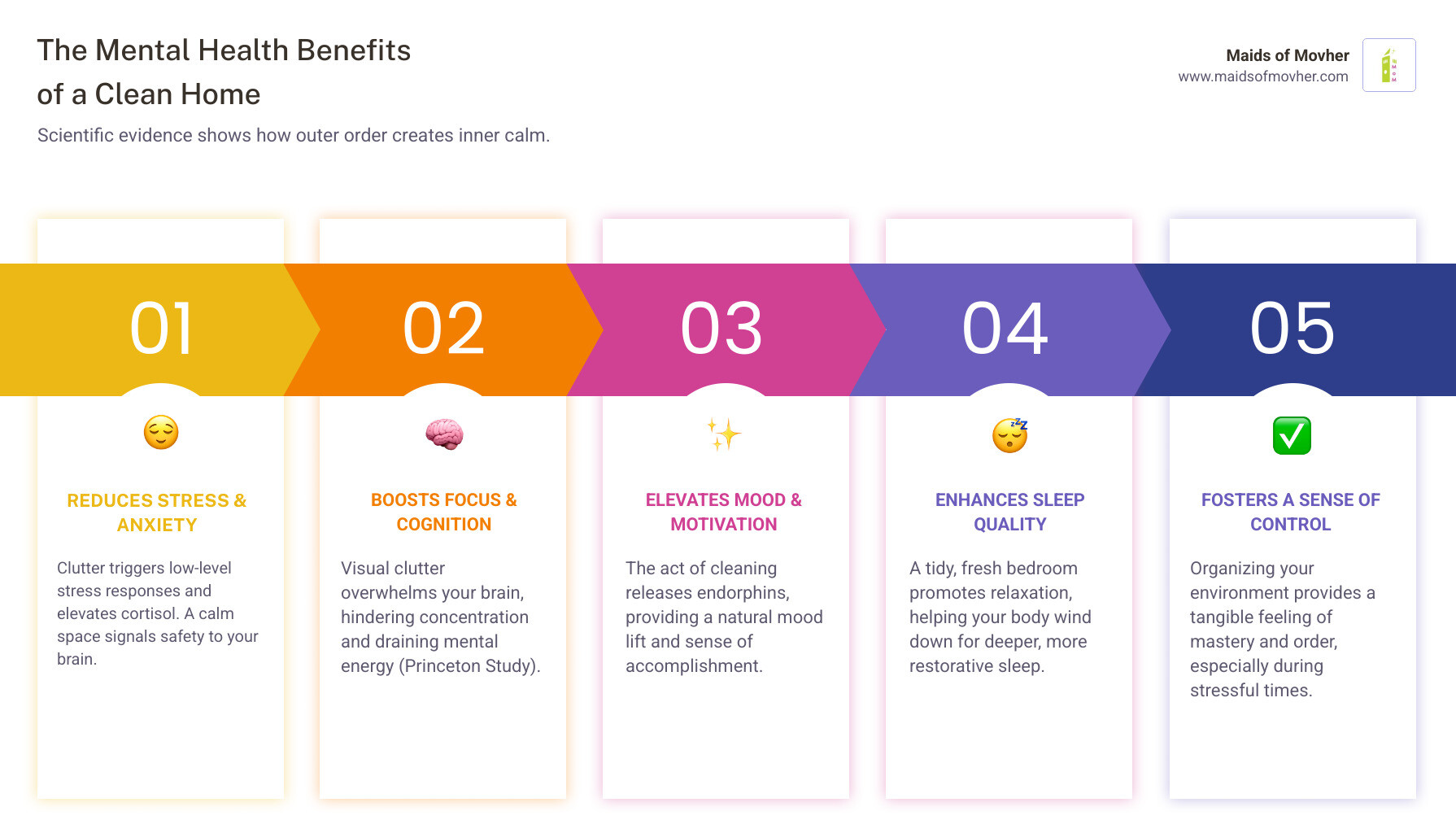
Here is a quick look at the key ways a clean home supports your mental health:
- Reduces stress and cortisol levels – Clutter signals unfinished business to your brain, keeping your body in a low-level stress response
- Improves focus and concentration – Visual disorder competes for your attention, making it harder to think clearly
- Boosts mood and motivation – The act of cleaning releases endorphins, giving you a natural mood lift
- Promotes better sleep – A tidy, fresh bedroom helps your body wind down and rest more deeply
- Restores a sense of control – Organizing your space gives you a feeling of mastery, especially during stressful periods
- Reduces anxiety – A calm environment signals safety to your nervous system, lowering feelings of worry
- Improves air quality – Regular cleaning removes dust, allergens, and pollutants that can affect brain function and mood
Research backs all of this up. A 2010 study found that people who described their homes as cluttered or full of unfinished projects were significantly more likely to report depression and fatigue. On the flip side, those who described their homes as restful and restorative reported better moods and mental health overall. And it is not just about how the space looks — the physical act of cleaning itself has measurable benefits, including a 27% reduction in nervousness reported by people who cleaned mindfully in one notable study.
The connection runs deeper than most people realize, touching everything from your brain’s visual processing to your cortisol levels and sleep quality.
I’m Sabrina Jones, owner of Maids of Movher and a home services entrepreneur with over a decade of experience seeing how a clean home improves mental health for the families and individuals we serve across the Spokane area. Whether you are managing a busy household or just trying to feel more at ease in your space, the insights in this guide will help you understand the science — and take action.
The Science of How a Clean Home Improves Mental Health
While we often think of cleaning as a physical chore, the most significant changes actually happen inside your brain. As of April 2026, environmental psychology has made massive strides in proving that our “outer order” directly influences our “inner calm.” When you walk into a room that is tidy and organized, your brain registers a sense of safety and completion.
One of the most famous studies on this topic comes from neuroscientists at Princeton University. They discovered that physical clutter competes for your attention. Your brain’s visual cortex can become overwhelmed by task-irrelevant objects, making it significantly harder to process information and focus on the job at hand. Essentially, every stray shoe or stack of mail is a tiny “visual noise” that drains your mental energy.
Furthermore, the state of your home regulates your hormones. A study published in the Personality and Social Psychology Bulletin found that women who described their living spaces as cluttered or full of “unfinished projects” had higher levels of cortisol—the body’s primary stress hormone—throughout the day. Chronic high cortisol is linked to anxiety, depression, and fatigue. By addressing the Signs Your Spokane Home Needs a Deep Clean, you aren’t just scrubbing floors; you are actively lowering your body’s physiological stress response.
Neurological Impact of Visual Order
Our brains are wired to seek patterns and order. When our environment is chaotic, our “cognitive load” increases. This means your brain has to work harder just to exist in the space. By creating visual order, you reduce brain fatigue. When you remove task-irrelevant objects from your line of sight, you free up mental “bandwidth,” leading to immediate focus enhancement and better decision-making.
How a Clean Home Improves Mental Health Through Endorphins
The act of cleaning is a form of “behavioral activation.” The physical activity involved—scrubbing, sweeping, and stretching—releases endorphins, which are the brain’s natural mood boosters and pain relievers. The repetitive motion of vacuuming or wiping counters can even have a meditative effect, grounding you in the present moment. This provides a sense of mastery and accomplishment; seeing a dirty surface become clean gives an immediate dopamine reward that tells your brain, “I am capable and in control.”
5 Ways Clutter Negatively Impacts Your Brain

It is easy to dismiss a messy room as a personality quirk, but for many, clutter acts as a silent thief of mental well-being. To the brain, clutter represents “unfinished business.” This creates a persistent, low-level anxiety that hums in the background of your life.
If you’re struggling to keep up, learning How to Clean Your House Without Worrying About Your Kids can be a game-changer for reducing the daily friction that leads to emotional exhaustion.
Sensory Overload and Anxiety
Clutter provides excessive stimuli for the nervous system. This sensory overload can lead to irritability and overstimulation. When your eyes constantly land on piles of laundry or unwashed dishes, your brain feels like it is being “shouted at” by your environment. Over time, this leads to mental noise that makes it impossible to fully relax, even when you are technically off the clock.
The Link Between Mess and Procrastination
There is a bidirectional relationship between mess and procrastination. A 2017 study found that clutter is a strong predictor of procrastination in young adults. When a space is overwhelming, we experience “decision fatigue”—we don’t know where to start, so we don’t start at all. This avoidance behavior can strain relationships and lead to a cycle of shame. Utilizing Reliable Residential Cleaning Washington can help break this cycle by resetting the environment to a manageable baseline.
Why a Clean Home Improves Mental Health Through Better Sleep and Air Quality
Your physical health and mental health are two sides of the same coin. A clean home improves both by optimizing your “rest and digest” functions. For example, the National Sleep Foundation has found that people who make their beds every morning are 19% more likely to report a good night’s sleep.
Using the right tools matters, too. Following a Safe House Cleaning Products Washington Guide ensures that you aren’t trading dust for harsh chemical fumes, which can irritate the nervous system.
Air Quality and Brain Function
We often forget that we “eat” the air in our homes. A 2022 literature review found that 95% of studies on air pollution and brain health concluded that exposure to pollutants changes the brain. In fact, 73% of people exposed to above-average indoor pollution showed more symptoms of mental health challenges. Using HEPA-filtered vacuums and following an Ultimate Guide Green Home Cleaning Products can raise oxygen levels in your brain, boosting mood and reducing brain fog.
Creating a Restorative Sleep Sanctuary
The ideal sleeping temperature is between 60-67°F, but temperature isn’t the only factor. A bedroom free of dust mites and clutter reduces the “micro-stressors” that wake you up during the night. Fresh linens and a sparkling environment signal to your brain that it is safe to enter deep, restorative sleep. This extends to your self-care areas as well; following The Ultimate Homeowner Guide to a Sparkling Bathroom ensures your nighttime routine happens in a spa-like sanctuary rather than a source of stress.
Practical Strategies for Maintaining a Clean Home for Mental Health
The goal isn’t perfection; it’s peace. If you feel overwhelmed, the best advice is to “start small.” You don’t need to clean the whole house today. You just need to win one corner. Many of our clients in Spokane and Liberty Lake find that Recurring Cleaning Services provide the necessary foundation so they can focus on small daily wins rather than massive, exhausting deep cleans.
Small Habits for Long-Term Wellness
Building habits takes anywhere from 21 to 66 days. Start with “habit stacking”—attach a new cleaning task to something you already do.
- The Bed-Making Momentum: As Navy SEALs suggest, making your bed is the first “win” of the day.
- The “Closing Shift”: Spend 10 minutes before bed clearing the kitchen sink and wiping one counter.
- Never Leave Empty-Handed: If you’re moving from the living room to the kitchen, take one item that belongs there. Consulting a Local House Cleaning Washington Guide can help you identify which habits offer the biggest mental “bang for your buck.”
Managing Cleanliness with ADHD or Depression
For those with ADHD or depression, cleaning can feel physically impossible. We recommend “energy matching.” If your energy is low, just fold five pieces of laundry. If you have a burst of energy, tackle the bathroom. “Body doubling”—having someone else in the room while you clean—can also help. And if you have furry friends, learning how to Keep Home Clean With Pets can prevent pet dander from becoming an added mental burden.
Navigating Compulsive Cleaning and Mental Health Barriers
It is important to recognize when cleaning shifts from a helpful tool to a source of distress. While a clean home improves mental health, obsessive cleaning can be a sign of OCD or high-functioning anxiety. Conversely, a total inability to clear clutter can sometimes signal hoarding disorder or severe depression.
If you find yourself in a “cleaning paralysis” where the mess is so great you can’t move, a Deep Cleaning Services Washington Guide can show you how professionals tackle the “impossible” jobs to give you a fresh start.
When to Seek Professional Support
If your house has become a source of shame or if you find yourself cleaning for hours to avoid processing difficult emotions, it may be time to speak with a mental health professional. Cleaning should be an act of self-care, not a punishment. When physical health or depression makes maintenance impossible, Healthy House Cleaning Washington services can step in to provide the support you need without judgment.
The Role of Professional Cleaning in Self-Care
Hiring help isn’t “lazy”—it’s a strategic investment in your mental health. By outsourcing the heavy lifting through a Recurring Cleaning Services Washington Guide, you buy back your time. That time can be spent on things that actually move the needle for your happiness: playing with your kids at Manito Park, catching up on sleep, or finally starting that hobby you’ve been putting off.
Frequently Asked Questions about Cleanliness and Wellness
How can I start cleaning when I feel completely overwhelmed?
Start with a “15-minute sprint.” Set a timer and focus on just one small area, like a single junk drawer or the kitchen table. Once the timer goes off, you have permission to stop. Often, the hardest part is just breaking the seal of procrastination.
Does a clean home really reduce symptoms of depression?
While it isn’t a “cure” for clinical depression, research shows it can significantly alleviate symptoms. A tidy environment reduces the “mental load,” making it easier to perform other self-care tasks. It also provides a sense of accomplishment that combats the feelings of helplessness often associated with depression.
What is the difference between being tidy and having a cleaning compulsion?
Tidiness is a choice that makes you feel better. A compulsion feels like a “must” that causes intense anxiety if not completed. If your cleaning habits are interfering with your social life, sleep, or work, or if you feel panicky when things aren’t “perfect,” it’s worth discussing with a therapist.
Conclusion
At Maids of Movher, we believe that how a clean home improves mental health is the most important part of what we do. Since 2010, we’ve been making homes sparkle across Spokane, Mead, and Airway Heights, but our real mission is to give our neighbors their peace of mind back.
As a locally and woman-owned business, we invest in our employees by paying the highest wages in the area, ensuring that the person entering your home is happy, professional, and dedicated to your well-being. We are also proud partners of Cleaning for a Reason, providing free services to cancer patients because we know that during life’s hardest battles, a clean home is a vital sanctuary.
You deserve a home that supports your happiness, not one that adds to your stress. Whether you need a one-time deep clean or ongoing support, we are here to help you reclaim your space and your smile.
Ready to experience the mental clarity of a truly clean home? Explore our Professional Cleaning Services Washington and let us help you make your home a place of rest and restoration.
