
Why the Debate Over Green Cleaning Products vs Traditional Cleaning Products Matters for Your Home
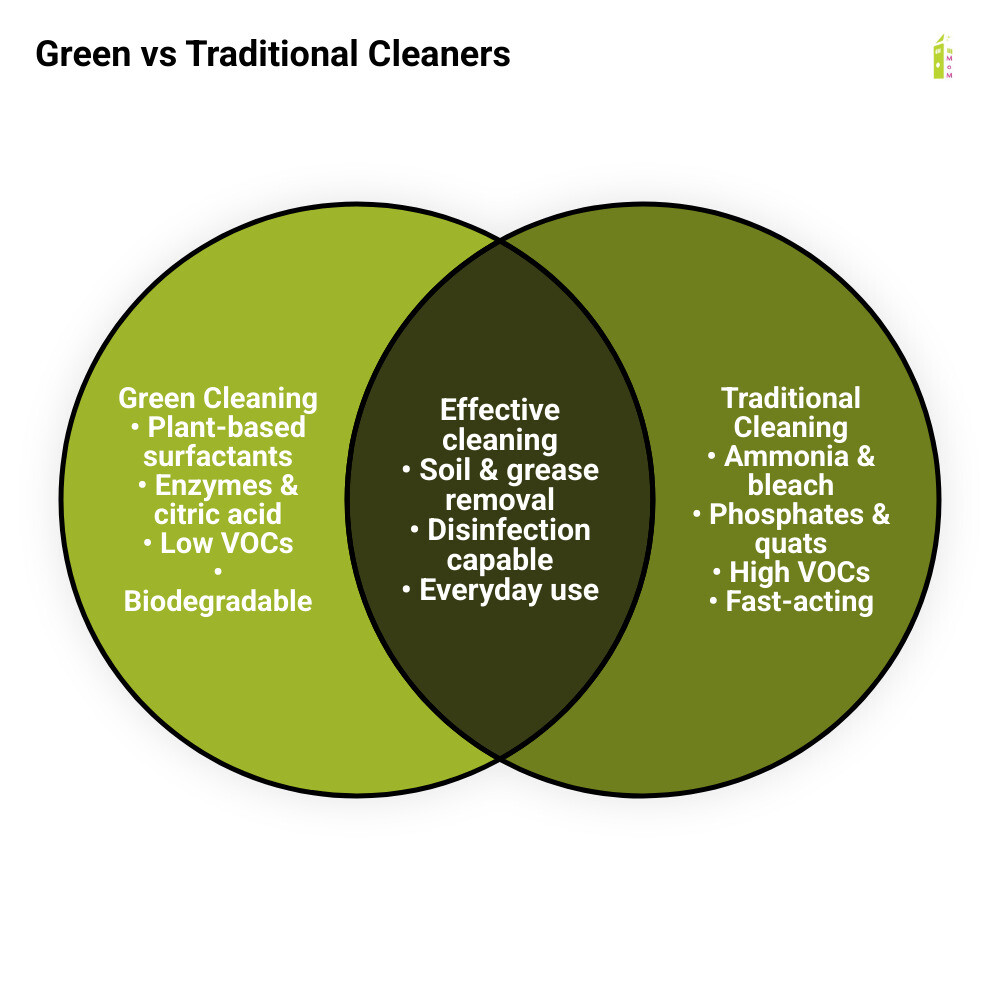
Green cleaning products vs traditional cleaning products differ in three core ways: ingredients, health impact, and environmental footprint. Here is a quick breakdown before we go deeper:
| Factor | Green Cleaning Products | Traditional Cleaning Products |
|---|---|---|
| Key Ingredients | Plant-based surfactants, citric acid, enzymes, minerals | Ammonia, chlorine bleach, phosphates, synthetic fragrances, VOCs |
| Health Risk | Lower – fewer irritants, reduced VOC exposure | Higher – linked to respiratory, dermal, and allergy symptoms |
| Effectiveness | Comparable – may need slightly longer contact time | Fast-acting, especially for heavy disinfection |
| Environmental Impact | Biodegradable, lower aquatic toxicity | Slow to break down, can pollute waterways |
| Packaging | Often concentrated, refillable, recyclable | Typically single-use plastic |
| Best For | Daily maintenance, homes with kids, pets, sensitive individuals | High-risk disinfection in commercial or industrial settings |
Walk down any cleaning aisle in 2026 and the shelves are packed with products making bold promises – “natural,” “plant-based,” “eco-friendly,” “non-toxic.” But what do those labels actually mean? And more importantly, does switching to green cleaners actually protect your family, or are you paying more for clever marketing?
The honest answer is: it depends on what you are cleaning, who is in your home, and whether the product you are holding has a real certification behind it – or just a leaf logo slapped on the label.
Traditional cleaning products have long relied on powerful synthetic chemicals like ammonia, chlorine bleach, and quaternary ammonium compounds. They work fast and disinfect effectively. But research, including a study of 329 professional custodians, found that workers with high exposure to traditional cleaning products had over four times the odds of developing dermal symptoms and nearly three times the odds of lower respiratory symptoms compared to those with low exposure. Green products showed weaker associations across the board – not perfect, but meaningfully safer.
Meanwhile, a separate scientific study found that some “green” products actually emit more monoterpenes than conventional ones, which can react indoors to form secondary pollutants like formaldehyde. That is the complexity this guide will help you navigate.
I’m Sabrina Jones, owner of Maids of Movher and a home services entrepreneur with over a decade of hands-on experience in the cleaning industry, where navigating the choice between green cleaning products vs traditional cleaning products has been central to building a healthier, safer service for Spokane families. I have seen how the right product choices protect both the people in a home and the people doing the cleaning.
Understanding the Ingredients: green cleaning products vs traditional cleaning products
To understand the real difference between these two categories, we have to look past the colorful labels and dive into the chemistry of what is actually inside the bottle. In our experience cleaning homes across Spokane and Liberty Lake, we’ve found that the “smell of clean” often hides a cocktail of synthetic substances.
Traditional cleaning products are often formulated with Volatile Organic Compounds (VOCs). These are chemicals that easily vaporize at room temperature. If you can smell a product, you are inhaling VOCs. Common offenders include:
- Ammonia: A powerful degreaser that can severely irritate the lungs and skin.
- Chlorine Bleach: Highly effective at killing germs but can create toxic gases if mixed with other cleaners.
- Phthalates: Often hidden under the generic term “fragrance,” these are linked to endocrine disruption.
- Phosphates: Used to soften water but known to cause major environmental issues when they reach our waterways.
In contrast, genuine green cleaning products utilize plant-based surfactants—the “soap” part of the cleaner—often derived from coconut oil or corn. Instead of synthetic dyes and heavy perfumes, they use minerals and botanical extracts. For a deeper look at what to keep in your cupboard, check out our Safe House Cleaning Products Washington Guide.
Performance Myths: Are green cleaning products vs traditional cleaning products Equally Effective?
One of the biggest hurdles we hear from homeowners in Airway Heights is the fear that green products just won’t “get the job done.” There is a persistent myth that if it doesn’t burn your nose, it isn’t working.
The truth is that modern plant-based chemistry has closed the gap. A 2019 study showed that EPA Safer Choice products removed 94% of test soils, compared to 96% for conventional cleaners—a difference so small it is statistically insignificant for home use.
However, there is a catch: dwell time. Traditional chemicals use aggressive solvents to “melt” grime instantly. Green products often require 5 to 10 minutes of contact time to break down grease and proteins effectively. We’ve found that by spraying a surface and letting it sit while we tackle another task, we get a sparkling result without the harsh fumes. Additionally, pairing these products with high-quality microfiber technology allows for superior mechanical action, picking up bacteria and dirt that cotton rags simply smear around.
The Role of Enzymes and Natural Acids in Modern Cleaning
The “secret sauce” in high-performing green cleaners often comes down to enzymes and natural acids. Enzymes are specialized proteins that act like little biological “Pac-Men.”
- Lipases break down fats and oils (perfect for kitchens).
- Proteases tackle protein stains like blood or grass.
- Amylases dissolve starches.
Natural acids like citric acid (from citrus) and acetic acid (vinegar) are masters at mineral removal. They lower the pH level of a solution to dissolve limescale and rust. While traditional acid cleaners might use phosphoric or hydrochloric acid, these natural alternatives provide a much safer way to keep your bathroom fixtures shining in Mead and Spokane Valley.
Health and Safety Impacts for Washington Households
When we talk about green cleaning products vs traditional cleaning products, we aren’t just talking about shiny counters; we are talking about the air your family breathes and the surfaces your toddlers crawl on.
The health data is compelling. In a large-scale study of custodians, those with high exposure to traditional products reported a 19% prevalence of dermatitis and a 42% rate of upper respiratory symptoms. While green products aren’t magically “risk-free”—high exposure was still linked to some dermal symptoms—the associations were uniformly weaker. For families in Spokane, this means that switching to green cleaners significantly lowers the “toxic load” in the home.
For those of us with furry family members, the stakes are even higher. Pets spend their lives low to the ground, licking their paws and grooming themselves. Residues from traditional floor cleaners can be easily ingested. You can learn more about keeping your four-legged friends safe in our Animal Safe Cleaning Products Washington guide.
Respiratory Benefits of green cleaning products vs traditional cleaning products
Indoor air quality is a major concern, as the EPA has noted that indoor air can be 2 to 5 times more polluted than outdoor air. Traditional cleaners contribute heavily to this through VOC emissions.
High traditional product exposure is associated with 2.42 times higher odds of upper respiratory symptoms and 2.93 times higher odds of lower respiratory symptoms. Even more concerning is the formation of secondary pollutants. When certain VOCs react with ozone in the air, they can form formaldehyde—a known carcinogen. By choosing products with low or no VOCs, you are directly improving the respiratory health of everyone in your household, especially those with asthma or allergies.
Protecting Vulnerable Populations in the Home
Children, pregnant women, and the elderly are particularly susceptible to chemical exposure. Many traditional cleaners contain endocrine disruptors that can interfere with hormonal development. Synthetic fragrances, which are found in nearly all conventional laundry and surface cleaners, are among the top five allergens in the world.
Green products that meet hypoallergenic standards and use non-toxic residues ensure that “clean” doesn’t come at the cost of long-term health. We believe that a home should be a sanctuary, not a source of chemical stress.
Environmental Footprint and Sustainability Standards
The impact of our cleaning choices travels far beyond our front doors in Liberty Lake. When you rinse a traditional cleaner down the drain, those chemicals eventually hit our local water systems.
| Environmental Factor | Natural/Green Cleaners | Traditional Chemical Cleaners |
|---|---|---|
| Biodegradability | Often 60-90% within 28 days | Can persist for years; slow to break down |
| Aquatic Toxicity | Low; formulated to protect fish/wildlife | High; can cause “fish kills” and reproductive issues |
| Water Pollution | Minimal; free of phosphates/nitrogen | High; contributes to algae blooms (eutrophication) |
| Carbon Footprint | Lower; often use renewable energy/short shipping | Higher; petroleum-based ingredients/long supply chains |
Phosphates and nitrogen, common in older traditional formulas, lead to nutrient loading in water bodies. This causes massive algae blooms that choke out oxygen and kill aquatic life. By 2026, sustainability goals for many Washington communities focus heavily on reducing these pollutants.
Packaging and Lifecycle Considerations
Sustainability isn’t just about what is in the bottle; it’s about the bottle itself. Traditional cleaners are mostly water, packaged in heavy single-use plastic, and shipped across the country.
Green cleaning leaders have pioneered concentrated formulas and refillable systems. By using a concentrate, you can reduce plastic waste by up to 80-90% and significantly cut down on the carbon emissions required for shipping. Many eco-friendly brands now use 100% recycled-content packaging and manufacture their products using renewable energy like wind or solar.
Identifying Genuine Solutions and Avoiding Greenwashing
“Greenwashing” is the practice of making a product appear more environmentally friendly than it actually is. It’s a huge problem in 2026. You might see a bottle with a picture of a forest and the word “natural,” but upon closer inspection, it still contains the same harsh sulfates and synthetic dyes as any other brand.
To avoid being misled, we always recommend looking for ingredient transparency. A company that is truly “green” will list every single ingredient on the label, not just hide behind the word “parfum” or “surfactants.” For a complete breakdown of how to vet your supplies, read our Ultimate Guide Green Home Cleaning Products.
Essential Certifications for the Conscious Consumer
Don’t take the manufacturer’s word for it—look for third-party verification. These organizations do the hard work of testing for you:
- EPA Safer Choice: Meets stringent human health and environmental criteria.
- Green Seal (GS-37): A gold standard for industrial and household cleaners.
- UL Ecologo: Verifies reduced environmental impact throughout the product’s life cycle.
- USDA Bio-Based: Confirms the product is made from renewable biological ingredients.
- Leaping Bunny: Guarantees no animal testing was involved.
Frequently Asked Questions about Natural Cleaning
How long should green disinfectants sit on a surface to be effective?
Most green disinfectants require a “dwell time” of about 10 minutes to kill 99.9% of germs. This is longer than some harsh chemicals, but it is the trade-off for having a non-toxic home. Always read the label for the specific product you are using.
Are natural cleaners safer for homes with senior citizens or those with chronic respiratory issues?
Yes, absolutely. Because green cleaners typically have much lower VOC levels, they are far less likely to trigger coughing fits, asthma attacks, or headaches. They improve indoor air quality, which is vital for those who spend a lot of time indoors.
Can I mix vinegar and baking soda for heavy-duty cleaning tasks?
While it looks cool because it fizzes, mixing the two actually neutralizes them. Vinegar is an acid and baking soda is a base; when combined, they mostly turn into salty water. It’s better to use baking soda as a scrub first, then rinse with vinegar to dissolve any remaining residue.
Conclusion
The choice between green cleaning products vs traditional cleaning products is no longer a matter of “clean vs. kind.” In 2026, you can have both. By understanding the chemistry behind your cleaners and looking for legitimate certifications, you can protect your family’s health and our beautiful Washington environment.
At Maids of Movher, we’ve been “Making Homes Sparkle Since 2010.” As a locally and woman-owned business in Spokane, we take immense pride in our employee-first philosophy. We believe that happy, well-paid employees provide the most consistent and reliable service for our clients. We aren’t just a cleaning company; we are members of this community, partnering with organizations like Cleaning for a Reason to provide free services to those battling cancer.
Whether you need recurring weekly cleaning or a deep “move-out” scrub, we are here to give you your weekends back. If you are looking for Eco Friendly Cleaning Services Washington, we would love to help. We serve Spokane, Spokane Valley, Mead, Airway Heights, and Liberty Lake with a commitment to integrity and a satisfaction guarantee. Let us bring the sparkle back to your home while keeping it safe for everyone inside.
